Showing posts with label Passion Projects. Show all posts

Thursday, August 13, 2015

Genius Hour 20 Day Challenge - Day 13: Help Wanted Board

Day 13: Help Wanted Board

When I need advice, I can't tell you how many times I've gone to Yelp to figure out which restaurant is best or if I want to spruce up a teaching unit how many times I've gone to Pinterest, Twitter, or asked my teaching friends.

We decided that this should transfer over to the classroom. Maybe Johnny Applejacks has an uncle who coached soccer who would be willing to talk to Susie Shopper about the best practices for goalies. Maybe Amy Anteater's mom is veterinarian and could give Marsha Matters tips about how to best care for her new french bulldog puppy. 

This is how we came up with an idea for an help wanted board!


We start by having every student write his or her question on a notecard or type up the questions. Make sure to include their names! 

Post things you need help with in blue- "Looking for someone with experience in X to interview. Contact Y and Z."   
As resources and suggestions become available from others, we will post them in yellow.

If students have a few minutes after completing an activity or when they first come to school, we encourage them to look at the board and see if they can offer suggestions or provide names of possible experts. (Remind students to include their names on the Post-Its! There's nothing worse than just having "my aunt" listed on a Post-It without knowing who wrote it!) 

This has been an AMAZING tool! The look on kids' faces as they get responses from neurosurgeons, veterinarians, engineers, pet store owners, and more is priceless! They feel so special that these experts are willing to help them with their projects. In addition, this sharing of resources may even provide an authentic audience for your students. We had one student design a hamster cage that better reflected a hamster's natural habitat and share it with a pet store owner. So cool!

You may even want to put this bulletin board outside your classroom and encourage other students or teachers to add their resources, too!

Another thing that we do is solicit help from parents in one of our weekly newsletters. We provide a list of questions and a short blurb like in our editable Genius Hour newsletter

If we get responses, we post these on our Help Wanted Board for students to use if they so choose.

We have also started to compile a list of experts on our Google Site for students to use as well. This list continues to grow year after year! 


Tuesday, August 11, 2015

Genius Hour 20 Day Challenge - Day 11: Final Questions & Final Project Discussion

Day 11: Final Questions & Final Project Discussion


You're almost there!


After you have students use their critical friends to review the question, they will come to you for final approval. The purpose of this stage is to help students tweak their questions, if needed, to make them more accessible or to push students a little further.


Before: How do you care for a Dwarf Hamster? 
After: How do you care for a Dwarf Hamster? How can we share this information with other kids who want to adopt a Dwarf Hamster?

Before: What are the different parts of the brain, and how do they work?
After: What are the different parts of the brain, and how do they work? How can I strengthen them?

Before: How can we learn new magic tricks?
After: How can we learn new magic tricks and create a show with everyday objects?


When we give advice to students, we ask them different questions to guide them into doing something with the information whether it's creating, sharing for a specific audience, modeling, or designing. For Genius Hour, we don't want our students to just regurgitate the information. We want them to DO something with the information that they get.

Try asking your students some of these questions to help them make their questions even stronger:
  • What will do or make with the information that you gather?
  • Who might be interested in learning about your research? How can you share this with them?
  • How can you show your learning?
Your students will be at different places. For some, coming up with the question will be easy-peasy. For those who get it right away, send them to do some pre-searching to get some basic information. for others, it will require some more prompting and questions.

Once everyone has their questions ready to do, you will notice a change in your step. Suddenly, you'll want to throw on your sunglasses and STRUT YOUR STUFF.


Monday, August 10, 2015

Genius Hour 20 Day Challenge - Day 10: Critical Friends

Day 10: Critical Friends


A critical friend is someone who is encouraging and supportive, but who also provides honest feedback. Critical friends provide feedback that is constructive and will help make your question/project/paper/speech even BETTER. Let's face it, critical friends can be your best friends!

If you have not seen the video, Austin's Butterfly, do yourself a favor and watch it now! This is a WONDERFUL video to show your kids, too, about how feedback can make our projects even better!


Image result for CRITICAL friend meme

We need critical friends who "keep it real." If your class is used to mainly giving positive feedback like "I like how Susie Snowbucket described the hamburger-it made me hungry" or "I like how Johnny Lunchbox started his paper with a question-it made me want to keep reading"....then you may want to do an activity or two like the ones below...


Alright, so now your friends are ready to "keep it real..."

After your students have developed their own inch, foot, and yard questions, they will pick one of the yard questions as their draft research question. Here's the form we use. 

Students will write draft research question at the top of the page. Independently, they should go down the list of questions on the sheet. If ANY of the answers are yes, then they should tweak their question until they get all no's. Then...it's time for that critical friend.


The critical friend will write his/her name on top of the chart and then provide feedback for each of the questions. 
Sometimes, kids hit it out of the park right away...other times, they need another shot at it.
It's okay! Just do it again...

When students are ready, they will come to you to get final approval. Some may need a tweak here or there...


It takes teamwork!


Sunday, August 9, 2015

Genius Hour 20 Day Challenge - Day 9: Question Drafts

Day 9: Question Drafts

WOOOOOHOOO! Your kids have research topics!

Now, it's time for the...


Research questions just don't appear out of nowhere, though. Before you can even start to answer a good solid research question (or YARD question!), you need to answer some smaller (INCH & FOOT) questions.

Our Genius Hour Preparation Activities will help you through all of this.


After students have narrowed down their topics into smaller categories, we have them start to develop their own inch, foot, and yard questions. This...can...get...tricky - but all this work is SO helpful in getting students to work on asking stronger and stronger questions.


This page can be found in the bundle [above].


Good research questions: 
  • requires you to use a source other than yourself to find the answer
  • can be researched - there is actually information out there to help you find the answer
  • not too broad (too much information that would take too long to find the answer), or not too narrow (little exploration)


Have your students focus on the categories of Some or A Little as they generate questions. They should try to come up with questions for topics that they want to dive deeper into. 

Have them refer back to the Inch, Foot, Yard posters in your classroom!


Don't worry...


A research question is coming....

Saturday, August 8, 2015

20 Day Genius Hour Challenge - Day 8: A Lot, Some, Little Activity

Day 8: A Lot, Some, Little Activity

Some students may be ready to go as soon as you give them the opportunity to pick ANY topic that they want to explore. Others may have ideas...
I Want To Know How They Have Done Their Research
that may need some work.

If this is your first time, you may want to have your students do a little pre-searching before picking a topic. When you pre-search, you use Google or any search engine to dig a little deeper into different topics.

Ask yourself:

  • What's new or interesting that I didn't know about this topic before?
  • What new questions do I have now?
  • Are there any connections that I can make with other topics?
After students have decided on a topic like "Dogs" or "3D Printing" or "kite-flying"...or...
We have students explore their topics a little further using an A Lot, Some, Little table (which is available on our TpT site - woohoo!)


Before you have kids do this, make sure you do 3 things: MODEL, MODEL, & MODEL!


Image result for male model zoolander

No. Not like that.

Walk your kids through the process. Without modeling, you will get a LOT of charts that look like this:

Topic: Dogs
A Lot: fluffy, hairy, big, 4 legs, 2 eyes, big tail, Rover is the best!


Remind your students to think about the smaller topics within each category. What do you know A LOT about? What do you know some things about, but maybe you aren't an expert in? What have you heard an adult talk about or one of your friends mention once or twice? 

As your students work on this chart, walk around and help them dive deeper into their topics and stretch themselves to add to the list. They will be using a topic from the Some or A Little category for their Genius Hour projects?


WAIT A MINUTE...WHAT'S THAT?! You have some kids who can't doooooooo it...take a step back. Maybe direct them toward our Growth Mindset posters. Do some pre-searching OR have them fill out a chart like this to get their juices flowin'!


Resources:

Science Kids: Fun Science & Technology for Kids  Includes a wide variety of science related topics with interactive resources.

Career Resources - What do you want to be when you grow up?  Includes links to learn about different careers.

Friday, August 7, 2015

Genius Hour 20 Day Challenge - Day 7: Searchable Words for Google

Day 7: Searchable Words for Google

Remember the Bloom's Taxonomy questioning post (Day 5)? Using questions from this activity allowed us to practice search terms. We just had students underline key search terms and write notes next to each question.

At this point, reiterate to your students that we want YARD questions, AKA questions that can't be answered in one search online. Therefore, the classic type in the whole question trick won't really work. Let's use this foot question to help guide:

What makes French Bulldogs unique?  


  1. What is the main topic of this question? French Bulldogs
  2. What other words are important? unique
  3. Are there any other synonyms or more specific words you can adjust to help find your answer? charactaristics instead of unique, traits instead of unique
  4. Google Search: French bulldog characteristics OR French bulldog traits

Always sample their search terms to see if you can actually find them. Try searching it even if they give a totally incorrect answer. We once had a student that suggested we search "What" and "makes" in this question (seriously). Instead of prompting the student, we just projected Google for him to see, and tried it out. We asked him to observe what came up, and he quickly realized that he needed the other words in the question to find his answer.

Let's use this higher level thinking question for an example now:

What is the difference between a French Bulldog and a Golden Retriever, and which is a better fit for my family? 


  1. What are the main topics? French Bulldog and Golden Retriever
  2. Since most sites probably won't have information on both topics, you might research each separately. 
  3. What other words are important? difference, family, fit
  4. Which part of this question can be found online, and which part requires us to draw OUR OWN conclusions? finding the difference can be found online, and deciding if it's a good fit can be done in my head
  5. What kinds of searches can help you find the differences between French Bulldogs and Golden Retreivers? 
  • care for French Bulldog
  • care for Golden Retriever
  • training French Bulldog
  • training Golden Retriever
  • French Bulldog activity
  • Golden Retriever activity
  • French Bulldog pros and cons
  • Golden Retriever pros and cons 

Why the focus on French Bulldogs you may ask? 


Seriously? Need I say more?

There's nothing wrong with sharing a good website with students, but providing feedback to help students with using better search terms is necessary. Here's an example of a way to help students find a website, but still allowing them to think about how their search terms affect what sites you find.


For more advanced Google-ers, this infographic may be helpful. Not sure I'm even at this level yet, but it would be a great poster for the classroom for students to refer to.


Thursday, August 6, 2015

Genius Hour 20 Day Challenge - Day 6: Reflection Practice


Day 6: Reflection Practice

Reflecting about the process and being metacognitive is an important part of the process. From the beginning of the year, I had students blogging and reflecting about their learning and their classroom behavior. This really helped them be more thorough in their Genius Hour reflections. Go to Lauren's Teachers Pay Teachers store to download this FREEBIE

You could also go to Kristin's TpT store to get this FREEBIE of Self-Reflection Starters.


If reflecting isn't a regular part of your day, at this point we recommend getting your students to start reflecting about the Genius Hour process. Don't expect in-depth, eye-opening, life changing realizations the first few reflection experiences. Many of the reflections at first was a lot like one of my favorite Bachelor contestant's response.


If you use a class blog like Weebly, KidBlog, or Edmodo, provide students with prompts such as: 
  • What was a challenge you faced today? How did you get through it?
  • What was something easy or enjoyable today? Why? 
  • What do you like or dislike about this step of Genius Hour? 
Keep the prompts fairly open-ended. If you feel that students aren't sharing enough, reply back with a follow up question.

Lauren here! Here are some examples of ways I incorporated reflection into my 4th grade classroom.

I had students revise their writing and reflect on the process.


Here's a reflection from a social studies primary source lesson.


At the end of the year, I had students share their plan for completing an at home volcano project, and then reflect on the process.


Wednesday, August 5, 2015

Genius Hour 20 Day Challenge - Day 5: Bloom's Taxonomy and Research Questions


Day 5: Bloom's Taxonomy and Research Questions


Now that students have a good understanding of the types of questions they should be asking, they need practice actually writing them! This lesson was extremely helpful to our students because, while they knew "yard" questions were the kinds they needed, they didn't know how to write them! For this activity, we provided students with a Blooms Taxonomy question starter page, and together we wrote questions based on a content area topic that we already had a significant amount of background knowledge on. This was helpful because in order to write higher level thinking questions about a topic, the student needs to have some level of background knowledge on the topic before being able to write a higher level thinking question about it.

The way we structured this lesson was starting out by selecting a topic then modeling writing a question or two using the Bloom's Taxonomy question starter prompts. We also threw in some non-examples. Students tend to "plug and chug" words in the blank, and sometimes it wouldn't make sense to research.

For example, I believe a student wrote, "What are the pros and cons of sea turtles?" 
Ha, like I said, it takes practice.


Download this Bloom's Taxonomy Questioning page here


After modeling one or two questions, I allowed students to craft their own and share with the class. As a class we decided if that fit, and if it was a researchable question. If it wasn't, then we talked through how we might change it to make it one.

By the end of the end of the activity, we concluded that the Analyzing, Evaluating, and Creating questions were the types of questions we wanted to write for our Genius Hour projects.

In our experience, even with the prompts, students still do need help with writing a good question based on their interests. Feedback, feedback, feedback...oh, and the upcoming activities help them get to that independent level!

Tuesday, August 4, 2015

Genius Hour 20 Day Challenge - Day 4: Researchable Questions - Inch, Foot, or Yard?

Day 4: Researchable Questions - Inch, Foot, or Yard? 


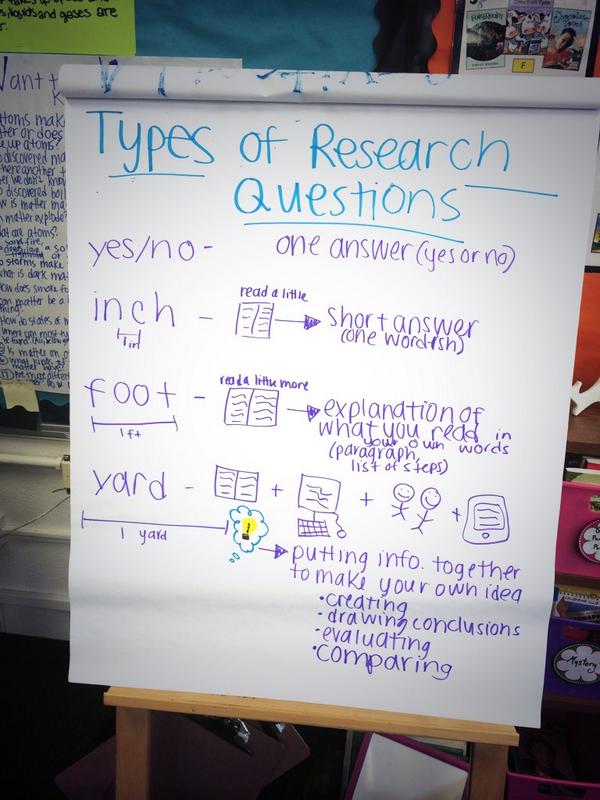
Questioning is such a crucial compnent to Genius Hour. Celebrate any questions students ask, because they need to know how great it is to ask and how rewarding it can be to find the answer! Higher level thinking questions allow for more thorough and challenging projects. Here is an anchor chart I used to help students understand the difference between different questions.

What's great about introducing questions in this way is that it's very visual for students. Students [should] know that an inch is the smallest, and a yard is the largest. This anchor chart categorizes types of questions into yes/no, inch, foot, and yard questions. I start by explaining what a researchable question is:

  • Requires you to use a source other than yourself to find the answer
  • It can be researched - there is actually information out there to help you find the answer
  • Not too broad (too much information that would take too long to find the answer), or not too narrow (little exploration)
Download this Researchable Question Posters FREEBIE to help students understand the difference!


YES/NO questions - A question that only has one answer: yes or no. It doesn't require much research.

INCH questions - A question that only requires a one word or short answer. It requires little research, and can be found in one source.

FOOT questions - A question that requires you to explain steps or summarize in your own words. It reqiures research for one or more sources.

YARD questions - In order to answer this question, it requires research from more than one source. When you put the information together, you make your own new idea. With this idea you can: create, draw conclusions, evaluate, and compare.

The goal for Genius Hour questions is for students to write Yard questions. Other questions, however, lead to Yard questions, so all questions are good as long as they are leading up to Yard questions. Download this printable for only $.99.


See a preview of the poster below! 


To help students understand the difference and classify questions, write your own inch, foot, and yard questions. Here's a FREEBIE with inch, foot, yard questions relating to matter. Posters come in a black background or a white background.


Continue practice with inch, foot, yard questions by incorporating it into everyday conversation. Align these questions to something you're learning about. Maybe take a KWL chart and have students categorize those questions. Questioning in guided reading is another natural way to allow students more practice with inch, foot, and yard questions.

Being able to classify questions is one thing, but writing questions presents another challenge for students. Tomorrow's post will show the activity we used to take on this challenge!