Showing posts with label Questioning. Show all posts

Tuesday, November 3, 2015

Building a Library of Books and Ideas!

Building a Library of Books and Ideas...for Genius Hour!!!

Before diving into a Genius Hour project, we spent some time discussing a growth mindset, practicing brainstorming, problem-solving, and collaborating. We had students practice peer feedback, make their learning visible in different ways, and reflect in a variety of ways. 

Our book discussions and activities with have helped us practice these skills and expose us to new ideas!

                         
               Activity                                               Activity                                                 Activity              


               Activity                                                                                                               Activity

(and more!) 

Picking A Topic for Genius Hour

In one of our previous posts, we had students complete an A Lot, Some, Little chart after picking a topic. This year, we spent some more time playing around with different ideas before getting to that lesson. 

Students Considered Their Passions...

We had students list out their favorite activities and their passions. We had students use each other as resources when brainstorming different topics. This was a good way to build community within the classroom.

Image result for dogs happy

Students Considered Their Heartaches...

And...this was an even better way to build community within the classroom. Students can easily make connections when they hear that someone else plays soccer or another person likes to play Minecraft. But when you hear another student is afraid of talking in front of the class or another person gets worried about making a mistake...that...that is how you build community. Often, it's the things that cause us sadness, heartache, or anger that cause us to take action and do something differently. We had students think more about problems in their schools and communities that they wanted to tackle. We also had students follow their hearts and consider what makes their hearts swell, as well as what makes their hearts ache. Check them all out here! Not only did we find that our classroom became a little closer, but it also sparked some new topics for Genius Hour that may not have come about without these activities!

Image result for bachelor crying rose no


We want to send a big SHOUT OUT to the monthly Genius Hour Chat for introducing us to this idea! It meets on Twitter (#geniushour) the first Thursday of every month at 8pm central time. Find us there! #20percentgenius

Tuesday, August 11, 2015

Genius Hour 20 Day Challenge - Day 11: Final Questions & Final Project Discussion

Day 11: Final Questions & Final Project Discussion


You're almost there!


After you have students use their critical friends to review the question, they will come to you for final approval. The purpose of this stage is to help students tweak their questions, if needed, to make them more accessible or to push students a little further.


Before: How do you care for a Dwarf Hamster? 
After: How do you care for a Dwarf Hamster? How can we share this information with other kids who want to adopt a Dwarf Hamster?

Before: What are the different parts of the brain, and how do they work?
After: What are the different parts of the brain, and how do they work? How can I strengthen them?

Before: How can we learn new magic tricks?
After: How can we learn new magic tricks and create a show with everyday objects?


When we give advice to students, we ask them different questions to guide them into doing something with the information whether it's creating, sharing for a specific audience, modeling, or designing. For Genius Hour, we don't want our students to just regurgitate the information. We want them to DO something with the information that they get.

Try asking your students some of these questions to help them make their questions even stronger:
  • What will do or make with the information that you gather?
  • Who might be interested in learning about your research? How can you share this with them?
  • How can you show your learning?
Your students will be at different places. For some, coming up with the question will be easy-peasy. For those who get it right away, send them to do some pre-searching to get some basic information. for others, it will require some more prompting and questions.

Once everyone has their questions ready to do, you will notice a change in your step. Suddenly, you'll want to throw on your sunglasses and STRUT YOUR STUFF.


Sunday, August 9, 2015

Genius Hour 20 Day Challenge - Day 9: Question Drafts

Day 9: Question Drafts

WOOOOOHOOO! Your kids have research topics!

Now, it's time for the...


Research questions just don't appear out of nowhere, though. Before you can even start to answer a good solid research question (or YARD question!), you need to answer some smaller (INCH & FOOT) questions.

Our Genius Hour Preparation Activities will help you through all of this.


After students have narrowed down their topics into smaller categories, we have them start to develop their own inch, foot, and yard questions. This...can...get...tricky - but all this work is SO helpful in getting students to work on asking stronger and stronger questions.


This page can be found in the bundle [above].


Good research questions: 
  • requires you to use a source other than yourself to find the answer
  • can be researched - there is actually information out there to help you find the answer
  • not too broad (too much information that would take too long to find the answer), or not too narrow (little exploration)


Have your students focus on the categories of Some or A Little as they generate questions. They should try to come up with questions for topics that they want to dive deeper into. 

Have them refer back to the Inch, Foot, Yard posters in your classroom!


Don't worry...


A research question is coming....

Saturday, August 8, 2015

20 Day Genius Hour Challenge - Day 8: A Lot, Some, Little Activity

Day 8: A Lot, Some, Little Activity

Some students may be ready to go as soon as you give them the opportunity to pick ANY topic that they want to explore. Others may have ideas...
I Want To Know How They Have Done Their Research
that may need some work.

If this is your first time, you may want to have your students do a little pre-searching before picking a topic. When you pre-search, you use Google or any search engine to dig a little deeper into different topics.

Ask yourself:

  • What's new or interesting that I didn't know about this topic before?
  • What new questions do I have now?
  • Are there any connections that I can make with other topics?
After students have decided on a topic like "Dogs" or "3D Printing" or "kite-flying"...or...
We have students explore their topics a little further using an A Lot, Some, Little table (which is available on our TpT site - woohoo!)


Before you have kids do this, make sure you do 3 things: MODEL, MODEL, & MODEL!


Image result for male model zoolander

No. Not like that.

Walk your kids through the process. Without modeling, you will get a LOT of charts that look like this:

Topic: Dogs
A Lot: fluffy, hairy, big, 4 legs, 2 eyes, big tail, Rover is the best!


Remind your students to think about the smaller topics within each category. What do you know A LOT about? What do you know some things about, but maybe you aren't an expert in? What have you heard an adult talk about or one of your friends mention once or twice? 

As your students work on this chart, walk around and help them dive deeper into their topics and stretch themselves to add to the list. They will be using a topic from the Some or A Little category for their Genius Hour projects?


WAIT A MINUTE...WHAT'S THAT?! You have some kids who can't doooooooo it...take a step back. Maybe direct them toward our Growth Mindset posters. Do some pre-searching OR have them fill out a chart like this to get their juices flowin'!


Resources:

Science Kids: Fun Science & Technology for Kids  Includes a wide variety of science related topics with interactive resources.

Career Resources - What do you want to be when you grow up?  Includes links to learn about different careers.

Wednesday, August 5, 2015

Genius Hour 20 Day Challenge - Day 5: Bloom's Taxonomy and Research Questions


Day 5: Bloom's Taxonomy and Research Questions


Now that students have a good understanding of the types of questions they should be asking, they need practice actually writing them! This lesson was extremely helpful to our students because, while they knew "yard" questions were the kinds they needed, they didn't know how to write them! For this activity, we provided students with a Blooms Taxonomy question starter page, and together we wrote questions based on a content area topic that we already had a significant amount of background knowledge on. This was helpful because in order to write higher level thinking questions about a topic, the student needs to have some level of background knowledge on the topic before being able to write a higher level thinking question about it.

The way we structured this lesson was starting out by selecting a topic then modeling writing a question or two using the Bloom's Taxonomy question starter prompts. We also threw in some non-examples. Students tend to "plug and chug" words in the blank, and sometimes it wouldn't make sense to research.

For example, I believe a student wrote, "What are the pros and cons of sea turtles?" 
Ha, like I said, it takes practice.


Download this Bloom's Taxonomy Questioning page here


After modeling one or two questions, I allowed students to craft their own and share with the class. As a class we decided if that fit, and if it was a researchable question. If it wasn't, then we talked through how we might change it to make it one.

By the end of the end of the activity, we concluded that the Analyzing, Evaluating, and Creating questions were the types of questions we wanted to write for our Genius Hour projects.

In our experience, even with the prompts, students still do need help with writing a good question based on their interests. Feedback, feedback, feedback...oh, and the upcoming activities help them get to that independent level!

Tuesday, August 4, 2015

Genius Hour 20 Day Challenge - Day 4: Researchable Questions - Inch, Foot, or Yard?

Day 4: Researchable Questions - Inch, Foot, or Yard? 


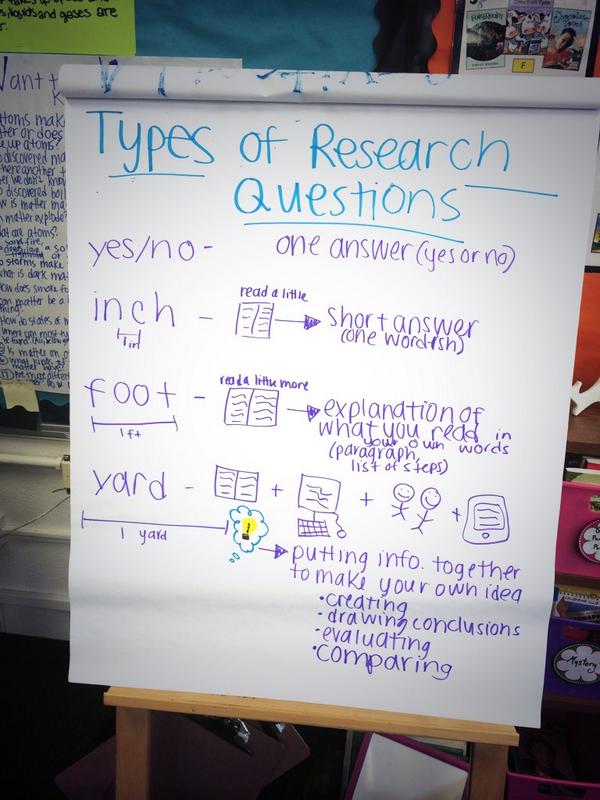
Questioning is such a crucial compnent to Genius Hour. Celebrate any questions students ask, because they need to know how great it is to ask and how rewarding it can be to find the answer! Higher level thinking questions allow for more thorough and challenging projects. Here is an anchor chart I used to help students understand the difference between different questions.

What's great about introducing questions in this way is that it's very visual for students. Students [should] know that an inch is the smallest, and a yard is the largest. This anchor chart categorizes types of questions into yes/no, inch, foot, and yard questions. I start by explaining what a researchable question is:

  • Requires you to use a source other than yourself to find the answer
  • It can be researched - there is actually information out there to help you find the answer
  • Not too broad (too much information that would take too long to find the answer), or not too narrow (little exploration)
Download this Researchable Question Posters FREEBIE to help students understand the difference!


YES/NO questions - A question that only has one answer: yes or no. It doesn't require much research.

INCH questions - A question that only requires a one word or short answer. It requires little research, and can be found in one source.

FOOT questions - A question that requires you to explain steps or summarize in your own words. It reqiures research for one or more sources.

YARD questions - In order to answer this question, it requires research from more than one source. When you put the information together, you make your own new idea. With this idea you can: create, draw conclusions, evaluate, and compare.

The goal for Genius Hour questions is for students to write Yard questions. Other questions, however, lead to Yard questions, so all questions are good as long as they are leading up to Yard questions. Download this printable for only $.99.


See a preview of the poster below! 


To help students understand the difference and classify questions, write your own inch, foot, and yard questions. Here's a FREEBIE with inch, foot, yard questions relating to matter. Posters come in a black background or a white background.


Continue practice with inch, foot, yard questions by incorporating it into everyday conversation. Align these questions to something you're learning about. Maybe take a KWL chart and have students categorize those questions. Questioning in guided reading is another natural way to allow students more practice with inch, foot, and yard questions.

Being able to classify questions is one thing, but writing questions presents another challenge for students. Tomorrow's post will show the activity we used to take on this challenge!

Friday, July 31, 2015

Genius Hour 20 Day Challenge


Two years ago we piloted a program (in our district referred to as Personalized Learning), but many refer to it as Genius Hour, Passion Projects, 20% Time, or any combination of those words combined. To stay consistent, we'll refer to it as Genius Hour, because that's what we're seeing used most frequently in the Social Media world -- but it's all very similar!

So...what is Genius Hour/Passion Projects/20% Time?! Genius Hour is where passions come alive! Students are given the opportunity to pose their own questions, problems, or challenges. With support, students will plan, manage, and reflect upon their learning. Students will switch roles from learner and teacher throughout the process. They will have the freedom to think independently and interdependently, take risks, and learn from their attempts. You and your students will not be able to get enough of it!

Follow along in this 20 day challenge to see one way to implement Genius Hour this school year! The goal is to work students up to independence. We'll be posting one post per day for 20 days!

These posts will include online resources, student examples, TpT Freebies, and MORE! Please feel free to ask questions and share your experiences! I'm looking forward to making my Genius Hour even more successful this year! 

"Since my first year teaching I've dabbled in Genius Hour components, but it wasn't till last year's pilot that I felt really good about what I was doing with these students. Why?? Because this is a new way of thinking for this kiddos, and you have to gradually work with them on this process! You can't expect to hand them a packet, and have them come up with something great. Feedback, collaboration, and scaffolding will get them there." 
- Lauren

Please note that this may take more than 20 days depending on how in-depth you get with the lessons.

Day 1: What is Genius Hour?
Day 2: Brainstorm Your Interests
Day 3: Website Evaluation
Day 4: Researchable Questions - Inch, Foot, or Yard?
Day 5: Bloom's Taxonomy and Research Questions
Day 6: Reflection Practice
Day 7:Searchable Words for Google
Day 8: A Lot, Some, Little Activity
Day 9: Question Drafts
Day 10: Critical Friends
Day 11: Finalizing Questions & Final Project Discussion
Day 12: Writing a Plan & Organization Tips
Day 13: Help Wanted Board
Day 14: Research & Problem Solving Minilesson
Day 15: Research & Setting Up an Interview
Day 16: Knowing When to Move On & Where Am I Board
Day 17: Conferring
Day 18: Creation Station & Video Tutorials
Day 19: Share!
Day 20: Genius Hour Self Evaluation